When Trust Matters

These are the words boldy visible when one steps into DNV‘s Singapore office. It is also at the forefront of nearly every presentation template in the company. It is also baked into the culture of the whole company. I previously wrote about trust and how the team I worked with operated with a lot of trust. After my second stint with DNV, where I had the opportunity to work with a largely renewed team, I can safely say with utmost confidence that while the people have changed, the culture hasn’t.

During my first stint, starting in December 2020, the team was starting to undergo a renewal. The old guard was leaving – some retiring, others taking up exciting new opportunities within the company – and the new guard was just entering one by one. The first of the new guard had just joined a month before I started.

I strongly believe that my line manager and the Area Business Development Director, Tony, took exceptional care to bring in people who would fit the team and the wider company culture. I do not mean people who are agreeable and would not raise objections or yes-men. Instead, it was people with different ways of thinking, background, character. But they all had one thing in common – the willingness to be a team player and the desire to perform both individually and as a team, along with the desire to keep improving and to help others improve.
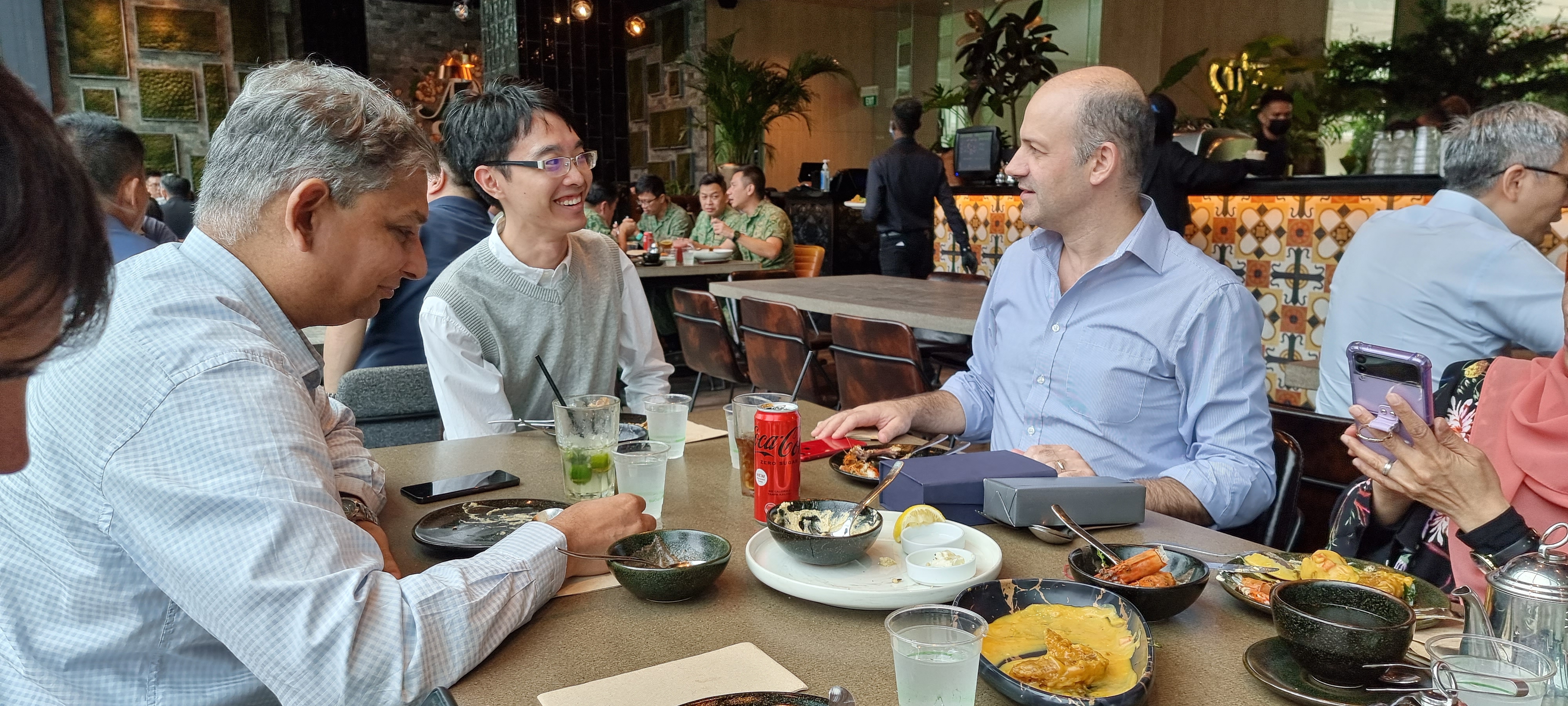
From left to right: Girish, me, Tony

One may think that in Business Development, the environment would be incredibly cutthroat and that every account manager would be competing against each other to get the best performance. It just isn’t the culture. The account managers help each other out, freely giving advice and assistance to those who ask without the slightest hesitation. There wasn’t competition within the team because they knew they were all in the same boat (pun intended?) and that it was more productive to have everyone performing at their best.

There was a conversation where the higher ups were the topic of discussion. In it, there were lots of praises going around about how the superiors always had their backs when it mattered, helping them fight battles that were sure to be lost but doing it anyway simply because they trusted those below them and knew it was a battle worth fighting. They weren’t concerned about how they would be perceived or having a perfect “win” rate. This gives those under the leaders at DNV the confidence to take risks or come out with bold ideas, that may or may not work but was still worth trying. This confidence and willingness to try can only help the team and the company advance. Because there is trust.

Author and speaker Simon Sinek has an anecdote he likes to use to teach about trusting the people you work with and creating the right environment. He once stayed at a Four Seasons hotel where he felt the staff were genuinely happy and welcoming, that they were sincere and not at all faking it because they were forced to act a certain way. Simon talks to a bartender, Noah, who loved his job and found out that he was also working at Caesars Palace but was just there to collect a salary.

At the Four Seasons, Noah said the managers were concerned about his well-being and providing an environment where he could thrive and be himself without fear of making mistakes. They would ask him how he was and what they could do the help him do his job better. This openness flowed into his job performance where he has no reservations about being himself and being genuinely happy to serve his customers.

At Caesars Palace, Noah’s managers were concerned about catching mistakes and reprimanding, creating a stuffy and pressured environment where he constantly felt like he was being watched. In time, he grew to keep his head down and never go the extra mile, to just get through the day and get his pay. All in fear of accidentally stepping out of some arbitrary line.

Simon would end of the anecdote by saying: “If we create the right environment, we get people like Noah at the Four Seasons. If we create the wrong environment, we get people like Noah at Caesars Palace. Same person, vastly different performance.”

From what I’ve seen, the leaders at DNV understands this and it flows throughout the organisation. One personal anecdote, an intern had just joined for a few weeks, still very green and learning the ropes. A manager had a quick chat with her, checking in on her, making sure she’s taken care of. She admitted that she was still a little lost. The manager told her not to worry, that once the month was over and things had settled down after all the events that were going on that month, they would have a sit down and talk about the support she needs and guide her accordingly. There wasn’t any judgement about why she wasn’t picking things up fast or doubts about her capability, only the willingness to make sure she has the help she needs to excel at her job and to help her learn as much as she can during her internship.

Whenever a mistake is made, the immediate action isn’t to find fault and mete out punishment. It is to rectify the mistake and to find ways to ensure that similar mistakes won’t happen or at least have its impact mitigated in the future. This fosters an environment where people are more willing to learn because they are far less afraid of making mistakes. They trust those above to know that they are human and things do go wrong sometimes, and with that trust, they are more willing to take responsibility for their actions and pass on that trust to those around them. Those above trust those under their charge to be responsible and to perform, and should there be a mistake, that it would be taken care of somehow.

I firmly believe that this is the key to creating a successful and sustainable company that would last.

It has been an incredible pleasure to work with the people in DNV and I sincerely hope that our paths would cross again in the future, no matter the capacity.
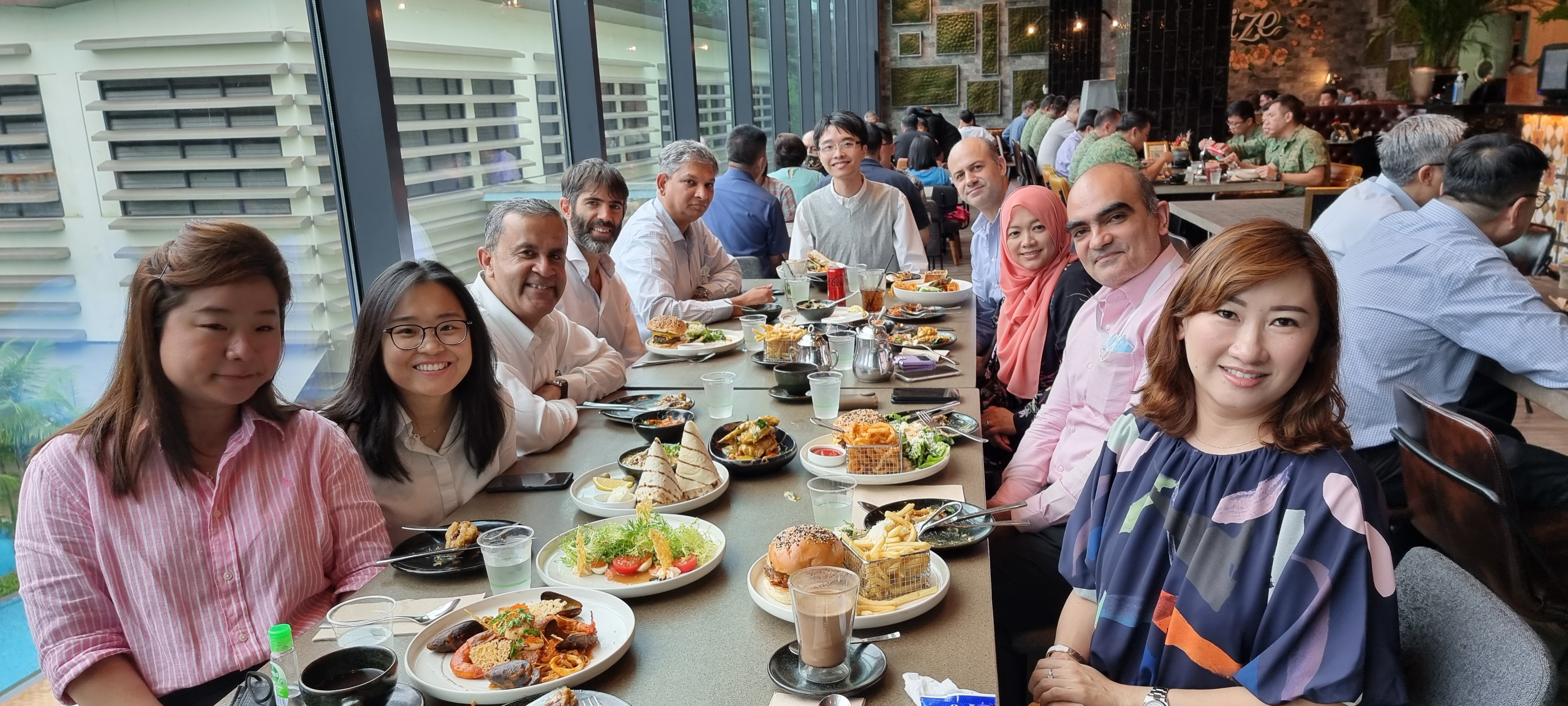
From left to right: Evon, Gabrielle, Kapil, Olivier, Girish, me, Tony, Siti, Gustad, Sharon

Teamwork

I’m really glad to have joined DNV and really fortunate that they accepted me.

DNV is a maritime classification society that conducts surveys, audits, and provides advisory services to vessel owners/managers all over the world. They provide many other services in other industries and sectors such as oil & gas, energy, supply chain. I was in the maritime business development department.

DNV has collaboration as one of their core values. The team I worked with and everyone else I’ve interacted with has shown me that they truly believe in this value. Any time I ran into issues, I never felt that I could not approach my senior colleagues for help or advice. They were always happy to answer my questions and provide me with guidance.

Everyone is invited to contribute ideas on how to improve the company’s processes, be it interns or senior executives. Everyone’s ideas were given fair consideration and credit.

A great deal of trust is also given within the team. Everyone is expected to play their part and were trusted to carry out their duties. I was not micromanaged on how I carried out my assigned tasks, I was simply given the required knowledge and allowed to complete it how I saw fit. Granted, there are many layers between what I do and the final execution so mistakes made at my level would not be significant in the grand scheme of things. However, when I complete my tasks well and without mistakes, it makes the job of those who build off of my tasks easier. Instead of having to spend time to rectify my mistakes, they can concentrate on carrying out their jobs, which would ultimately impact the team’s performance.

Working together and cooperating seems so easy and logical. Yet, many somehow fail to grasp that. Or maybe they do but they prioritise their individual goals over that of the team and choose to sabotage others so they may rise higher.

Things doesn’t always go as planned

During my time in Embry-Riddle, I made a few videos as part of my coursework, one of which is an advertisement for the school. The initial concept of this video and the final product were the same and yet, it ended up being very different from how I had initially envisioned it.

I pitched the idea of creating a video advertisement for my school at the time to my group as our class project and they agreed. We were all unaware of how big this project would eventually become (although in hindsight, we probably should have).

As Embry-Riddle is an aviation focused school, most of its advertisements are naturally showcasing its ability to impart aviation knowledge and train aviators. Had I been the one in charge of the school’s marketing campaigns, I would do that too. It’s the obvious choice.

However, we did not have the luxury of time, resources or access to the school’s aviation facility (because we’re in Singapore and said facilities are in the US). So I looked at what was more reasonable with what I had available. That’s how I arrived at the video’s concept, which focused on promoting learning as something that is at the core of what school is.

It is a generic idea, nothing groundbreaking or unique. That said, I believe that a boring idea with great execution is better than a great idea with mediocre execution.

To film this, I used my mobile phone (Pixel 3) and borrowed a DJI Pocket from a friend. I wrote a script to give an idea for what the video would be like and we went from there. We planned the shots, decided on the angles, who would be in the shots, all that fun stuff.

Then we started filming.

Murphy’s law states that anything that can go wrong will go wrong (don’t quote me on that). Some shots we wanted turned out to be not as feasible as when we were planning and scouting areas, others were cut short due to time constraints. I’d say that about half the shots I initially wanted didn’t get filmed.

They were instead replaced by other shots that we improvised, along with others that I filmed during breaks and while waiting for classes to start.

I was glad I got those shots though.

Those were some of the most genuine shots of my schoolmates I’ve gotten as they were simply going about their day, doing their work instead of having to act. Those shots were far better than anything I could’ve tried to direct/script.

My favourite shot was of my three friends laughing together in a corridor because of something funny that our classmate did. When I stopped recording, I remember thinking that it was one of the best things I’ve filmed for this project. And I wouldn’t have filmed it if I forced myself to stick to the planned script and only captured what we had discussed.

In the end, I think life is like that some times. You don’t always get what you want nor will things always go as planned. But sometimes, what you wanted or planned may not be as good as what you actually get.

(If you’re reading this on the main page, the video might not be embedding properly) Have to figure this one out.

Trust and Integrity

Trust and integrity. When dealing with others, we always have a choice: to be truthful and sincere, or to be deceitful. I believe that we should choose the former because any relationship, personal or professional is fundamentally based on trust. While we cannot stop others from choosing to lie, we can choose to act with integrity ourselves.

Have I lied before? Yes, I have. But as I grow and make new connections, I learnt over time that there is no meaning in forming one based on a lie. There can be no trust if I do not have integrity and my word will mean nothing. A relationship that lacks trust can only be toxic and unproductive. On the other hand, a relationship where both parties are able to trust each other has the potential to be beneficial for both since no effort has to be wasted on finding out whether the other person is lying or not.

Trust is also more than knowing that the other person is being honest. It is also having faith in other people’s abilities. This became most apparent to me when I was delegating tasks to my team members for group projects in school.

While discussing the direction the group’s presentation should take, my team gave valid suggestions. However, I let my distrust and ego get in the way. I forced my idea in and dismissed theirs because I did not have faith in them. In the end, my team was given a lacklustre score while teams that took a direction similar to those suggested by my teammates received excellent scores.

I thought I knew best and did not trust that my teammates could also have valid ideas. I apologised to my team for my inflexibility. From then on, I made sure to consider the perspectives of others thoroughly before rejecting it.

Everyone has their strengths and weaknesses. I need to trust and play to the strengths of my team while ensuring that their weaknesses are covered for instead of letting it define them. This manner of leadership, in my opinion, is more productive in the long run. The team will feel more appreciated and respected, and the work we do will be better for it. I am glad to have learnt this lesson in school where the stakes are lower and I aim to not repeat it in the future.

Black Mirror: Bandersnatch – Did Netflix pull it off?

So Season 5 of Black Mirror is returning with Black Mirror: Bandersnatch at the forefront. It’ll have an interactive choose your own adventure element to the story, allowing the viewer to make decisions that would alter the story. This sounds like an amazing idea in theory but how well can they execute it?

This is very reminiscent of the now defunct Telltale’s games (Tales from the Borderlands, The Wolf Among Us, The Walking Dead, Game of Thrones, etc.). The thing about these games is that the choices you make don’t really alter the story all that much in the grand scheme of things and when you do go back to make those choices again, it gets repetitive.

So how did the creative team behind Black Mirror pull it off? In my opinion, flawlessly.

Ok so, here’s the thing. Your choices don’t matter in Bandersnatch, to an extent. But this is all part of the narrative. The way they handle the scenes that you have to rewatch is brilliant as well. Most of the scenes you have to rewatch are edited down into snippets that tells you where in the timeline you are. Then there are a few scenes where you rewatch in its entirety. Watch out for those scenes because things are not the same in those.

The first choice that I made that caused a rewind happened pretty early on in the movie. When it replayed I was immediately worried that the repetitiveness was going to set in and that it would happen for pretty much all my choices later in the movie. As soon as I had that fear, the scene proved the fear unfounded with altered dialogue that foreshadows plot points later in the movie.

The characters get a bit meta at some points and one route full on lets you break the fourth wall and the character becomes self-aware that they are not in control of their choices. That path leads to a pretty hilarious ending (think Monty Python and the Holy Grail’s ending), if you pick the right options. There are some inconsequential choices thrown in that won’t have any impact on the narrative but will alter some background things.

They also do a great job in making sure the scenes flow well into one another no matter which choice you pick, so you won’t know whether you’ve made the “right” choice until it has played itself out. There is a time limit on how long you can dwell on your choices so that helps remove the awkward pause in dialogue and actions (but then again, Telltale’s games also had a time limit) so the scene and dialogue is written in a way that makes those few seconds where you’re making your decision not feel stilted at all.

The overall narrative felt very cohesive and played out in a way that takes full advantage of the rewind instead of feeling like you’re only watching part of a story. When I say it takes full advantage of the rewind, I mean that you’re guided to an ending that the writers want you to reach (something that is hinted at in the show itself).

I can only say that I hope Netflix and other content producers would make more media like Bandersnatch, if they are all as well executed, that is.